
Culture First: Why Digital Inclusion Depends on People, Not Tech
13 January 2026
Culture First: Why Digital Inclusion Depends on People, Not Tech
In the third sector, digital inclusion is often misunderstood as simply access to a device or basic technical skills. But in reality, it is about something much deeper — confidence, connection, agency, participation, voice, and belonging. Whether digital inclusion becomes a meaningful part of everyday support work is shaped not by technology alone, but by organisational culture, leadership attitudes, and staff belief in the value of digital inclusion as part of their role.
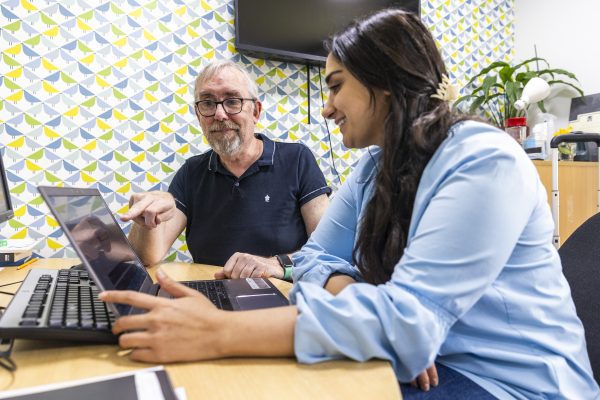
When digital engagement is seen as optional or secondary — something to be bolted onto “real work” — it is rarely embedded meaningfully into how organisations support people. Staff may end up completing digital tasks for people instead of with them. This might feel helpful in the moment, but it unintentionally reinforces digital dependency rather than enabling people to build their own skills and confidence.
Crucially, staff digital competence alone is not what determines whether digital inclusion becomes part of support practice. What matters more is whether staff believe that digital inclusion is part of support work — that it is relational, empowering, and aligned with the organisation’s mission. And that belief is shaped by leadership and culture.
When leaders talk about digital inclusion as part of empowerment, voice, participation, and rights — rather than a technical or efficiency-driven priority — staff begin to see it as a meaningful part of their professional identity. Digital stops being “IT work” and becomes support work. It becomes about people, not devices. In these environments, digital inclusion is embedded naturally through modelling, coaching, and scaffolding — not as an extra task, but as part of everyday relational support.
However, when digital is avoided or downplayed by those at senior levels, staff interpret this as a sign that digital inclusion support is optional or someone else’s responsibility. This leads to hesitation, uncertainty, or even reluctance to engage digitally with people, reinforcing the very barriers we want to break down. Culture is what makes the difference.
When I started at Simon Community Scotland in 2022, I saw firsthand how powerful leadership belief can be. From early on, digital inclusion was framed by senior leaders not as a technical initiative, but as an extension of our core values — voice, participation, empowerment, and dignity. That gave us a head start. It meant digital was recognised as human work, not IT work.
But even with strong leadership support, change didn’t happen overnight. It took time for some frontline staff to grow in their own confidence and belief that digital inclusion was part of their role. Nearly three years on, some colleagues are still on that journey. That doesn’t mean failure — it simply reflects reality. Organisational culture doesn’t shift just because we launch a project; it evolves through belief, trust, and lived experience.
To understand this better, we surveyed staff to explore their digital attitudes and confidence. The findings were telling:
- 83% recognised the importance of the people we support being digitally included
- But 70% said they did not feel confident supporting others to develop digital skills
- 41% worried about friends or family being vulnerable online
- 40% believed more digital knowledge would help them in their role
These results highlight a key insight: digital inclusion is not just about skill — it is about belief, confidence, safety, identity, and culture.
High staff turnover means that the focus must be actively maintained — not assumed. We tend to recruit people for their values, empathy, and relational strengths, not for their digital knowledge. That means the principles of digital inclusion must be introduced early, embedded in induction, then reinforced through peer learning, reflective supervision, and role modelling.
Digital inclusion cannot depend on a single role, team, or project. It must live in the culture — not the training calendar.Because digital inclusion is not a programme, it is a principle.
Digital inclusion is not just about helping people get online.
It is about helping people take part.
To have a voice.
To be seen.
To stay connected.
To shape their own lives.
In the third sector, we do not talk about technology — we talk about people.
But today, technology is woven into how people connect, learn, work, organise, advocate, and belong. Which means digital inclusion is no longer a nice-to-have or an “extra”— It is part of our duty of care.
The question is no longer “Do we do digital?” — but rather — “Do our people have the power to take part in a digital society?”And that doesn’t begin with devices, or training, or toolkits. It begins with us.
It begins with what we believe about digital inclusion — What we talk about, value, model, and make possible in our organisations.
So, here is the invitation:
Leaders: Name digital inclusion as a relational, values-driven practice — not an IT function.
Managers: Create cultures where learning, experimenting, and failing safely with digital is welcome.
Frontline staff: Don’t do digital for people — do it with them. Build digital confidence, not digital dependency.
Organisations: Embed digital inclusion in your values, strategy, induction, peer support, and storytelling — not in a side project.
Because when digital inclusion becomes everyone’s business — We don’t just help people use technology. We help people connect, be heard, belong, and thrive.
Digital inclusion is not about tech. It is about people, power, participation, and possibility.
Nigel Gallear, Digital Inclusion Programme Manager